Ancient Merv: Murghab Delta Urban Complex Preserves Several Historical Periods
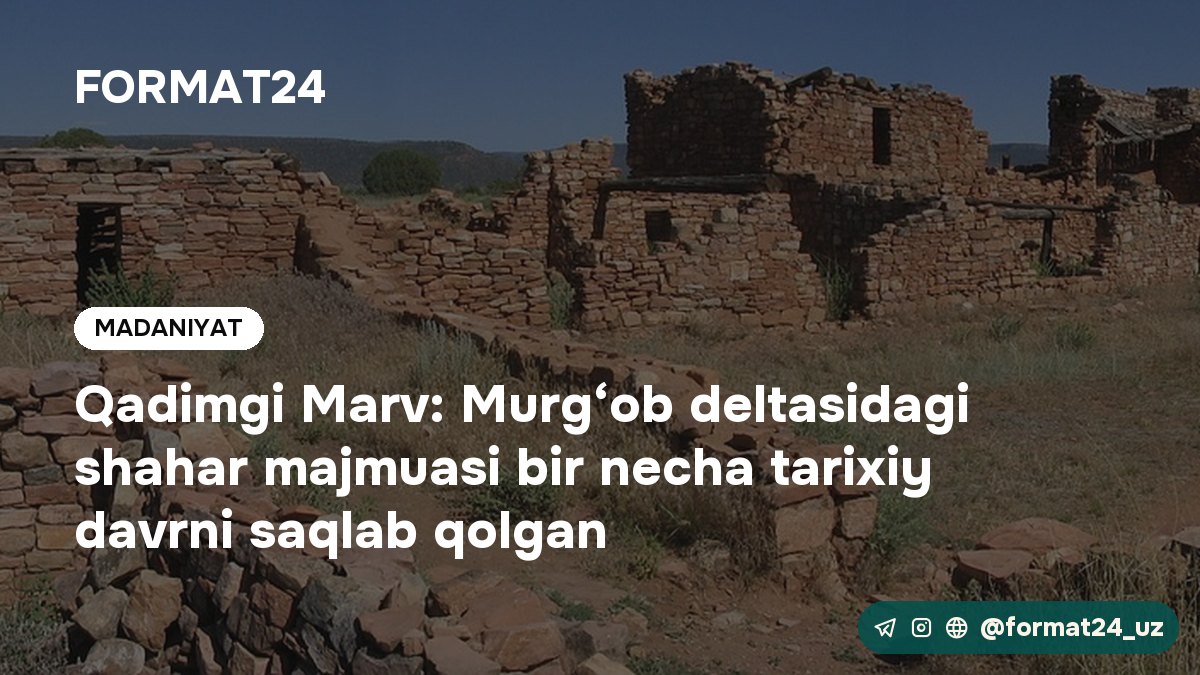
Russian and British archaeologists have shared information about the history of the ancient ruins of Merv, located among the Karakum Desert in the territory of present-day Turkmenistan.
Nadezhda Dubova, head of the Russian-Turkmen Margiana Archaeological Expedition, and Professor Timothy Williams of University College London (UCL), director of the international project “Ancient Merv,” explained the city’s location and significance.
Merv’s development was linked to the Murghab River delta. The river does not flow into another river or the sea; in the north it disappears among the sands. Over thousands of years the delta has shifted southwest: in the 3rd–2nd millennia BCE it was 80 kilometers north of today’s Bayramali, and in the 11th–12th centuries it reached the Bayramali area. Today the Murghab has shifted by about 30 kilometers, and the shift continues.
Dubova noted that trade links in the region took shape well before the Great Silk Road. As early as the 4th millennium BCE, lapis lazuli was transported from Badakhshan to Mesopotamia, Egypt and the Indus valley via the “Lapis Lazuli Route.” Later, trade in copper, bronze and lead developed.
Williams sees Merv’s distinctiveness in the fact that new cities were built alongside older ones rather than on top of them, so archaeologists can study different periods within a single complex. The first city center was Erk Kala.
For reference, Merv reached its highest level of development during the Seljuk period, and in 1999 the “Ancient Merv” State Historical and Cultural Park was included in UNESCO’s World Heritage List.
Source: Daryo